
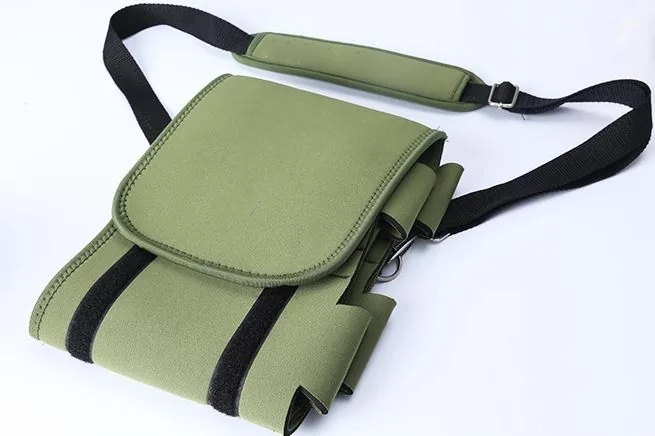
Neoprene-style sheet material can create soft sleeves, bottle holders, pouches, totes and equipment carriers, but the word “neoprene” is not a complete specification. Two visually similar sheets can differ in core, textile faces, thickness, density, stretch, recovery, odour, lamination and processing behaviour.
Direct answer: In bag sourcing, neoprene bag material commonly means a soft sponge or rubber-like core laminated to textile on one or both faces. Specify the exact core or supplier grade, face fabrics, lamination, core and total thickness, tolerance, colour, edge finish and required tests. A generic “neoprene” label does not prove cushioning, insulation, waterproofness, chemical resistance, temperature range, sustainability, compliance or service life.
Neoprene bag material at a glance
| Decision | What to define | What not to assume |
|---|---|---|
| Material identity | Supplier code, core description, blend or grade and supporting data | That every “neoprene” sheet has the same composition |
| Lamination | Face fabric on each side, adhesive or bonding route and finish | That the visible textile identifies the hidden core |
| Thickness | Core thickness, total thickness, test method and tolerance | That a thicker number guarantees protection or warmth |
| Physical behaviour | Hand, stretch direction, recovery, density or hardness when relevant | That one swatch represents every colour and production lot |
| Construction | Pattern allowance, seam, edge, closure and reinforcement | That a flexible sheet can use any ordinary bag pattern unchanged |
| Branding | Exact face fabric, process, artwork, colour and strike-off | That all prints adhere, stretch or age in the same way |
| Performance | Named finished-product test with conditions and pass rule | “Shockproof,” “waterproof” or thermal performance from appearance |
| Evidence | Exact material, sample, report scope, market and intended use | Universal compliance or sustainability from a marketing name |
Begin with the item and use case. A close-fitting drink sleeve, a zippered electronics sleeve and a shoulder-carried equipment pouch impose different fit, seam, attachment and evidence requirements even if they use a similar-looking sheet.
First confirm what “neoprene” means for the project
Supplier terminology can include neoprene, CR, SBR, blends or broader neoprene-style descriptions. These labels may indicate a proposed material family, but they are not interchangeable specifications. Ask the supplier to identify:
- commercial name and supplier or mill reference;
- declared core material or blend, where disclosure is required;
- production grade, colour and surface condition;
- face textile on side A and side B;
- lamination or bonding construction;
- nominal core thickness and total laminated thickness;
- tolerance and measurement method;
- density, hardness, compression or recovery criteria when functionally relevant;
- roll width, usable width and orientation constraints;
- care, storage and processing limitations;
- applicable documents for the exact grade and intended market.
If an exact chemical identity or restricted-substance conclusion matters, use supplier documentation and project-specific testing. Do not infer it from a product name, colour or hand feel.
Core, face fabric and adhesive form one construction
The core supplies much of the sheet’s thickness and flexible body. The textile face affects touch, colour, print behaviour, abrasion exposure, friction and sewing. The lamination holds those layers together through cutting, forming, use and care. A material approval should therefore identify all three, not only the core.
One-side lamination can leave a different inner surface from two-side lamination. Two textile faces may also be different: for example, the outside can be selected for branding while the inside is chosen for contact, friction or cleaning. Record side orientation on the pattern and bill of materials so production does not reverse them.
Adhesive visibility, bubbles, wrinkles, edge lifting and delamination are practical approval points. If heat, moisture, flexing or cleaning is part of use, reproduce that exposure on the exact laminated construction before setting a claim.
Thickness needs a method, location and tolerance
“Use 3 mm neoprene” can remain ambiguous. The number might describe the core before lamination, a nominal supplier grade or the measured total construction. Soft materials compress under the measuring foot, so equipment, pressure, dwell time and location can change the reading.
Define whether the controlled value is core thickness, total laminated thickness or both. State the instrument or agreed method, measurement locations, conditioning, tolerance and treatment of textured surfaces. Keep the approved swatch or reference sample with the written value.
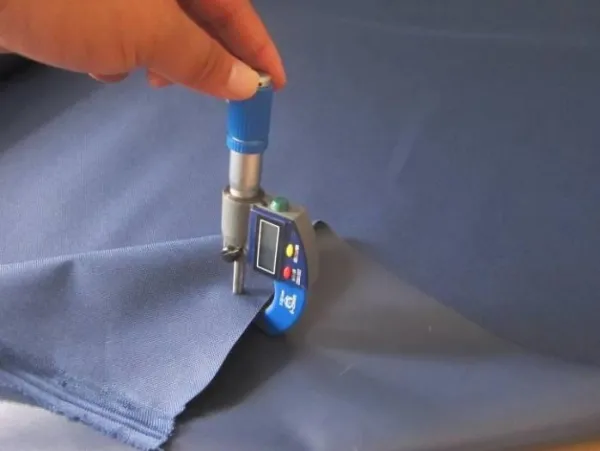
Thickness is meaningful only with a consistent measurement method. It should not be used alone as proof of cushioning, thermal performance or durability.
Thicker material does not automatically mean better protection
Extra thickness can add body or separation, but protection depends on more than a millimetre value. Core behaviour, compression, recovery, coverage, seams, openings, hard components, product fit and the impact direction all matter. A loose sleeve can allow movement; an overly tight sleeve can compress the sheet and stress the closure.
Replace “shockproof” with a defined requirement. Record the protected item, mass, geometry, vulnerable zones, packed orientation, drop or compression method, surface, height or force, sample condition and pass criteria. Test the complete packed product, not a flat sheet alone.
Match stretch and recovery to the required fit
Some soft laminated constructions stretch differently along their length and width. Pattern orientation can therefore affect fit, opening force, print distortion and how an edge sits. Measure and approve the orientation rather than assuming uniform stretch.
For fitted sleeves, provide the actual item or a controlled dimensional model. Define whether the fit should grip, slide easily or allow clearance for a case, cable, cap or handle. Check insertion and removal over repeated cycles. The finished internal space is affected by material thickness, seam allowance, edge binding and closure construction.
Pattern allowance must reflect material bulk
A paper pattern based only on outside dimensions can produce the wrong usable space. Thick, compressible sheet consumes space at folds, corners and seams. Binding and zipper tape add more bulk. Curves may flatten, and a multi-layer junction can become stiff.
Prototype the exact material stack. Measure both finished outside dimensions and usable inside fit under an agreed condition. Review corners, opening clearance and the item insertion path. When changing material thickness or face fabric, reconfirm the pattern rather than treating the substitution as cosmetic.
Select the edge finish before finalizing the pattern
Possible edge directions include a controlled raw edge, overedge stitching, folded or applied binding, a joined-and-turned seam, or a project-specific bonded construction. Suitability depends on the exact laminate, appearance, stretch, contact surface, production method and durability requirement.
Raw edges expose the layer stack and demand consistent cutting. Binding can protect the edge and add colour, but it also changes stiffness, seam bulk and usable dimensions. Overedge stitching creates a distinct visual frame and must be approved for thread coverage, spacing and stretch. Turned construction can hide an edge but may be impractical at thick intersections.
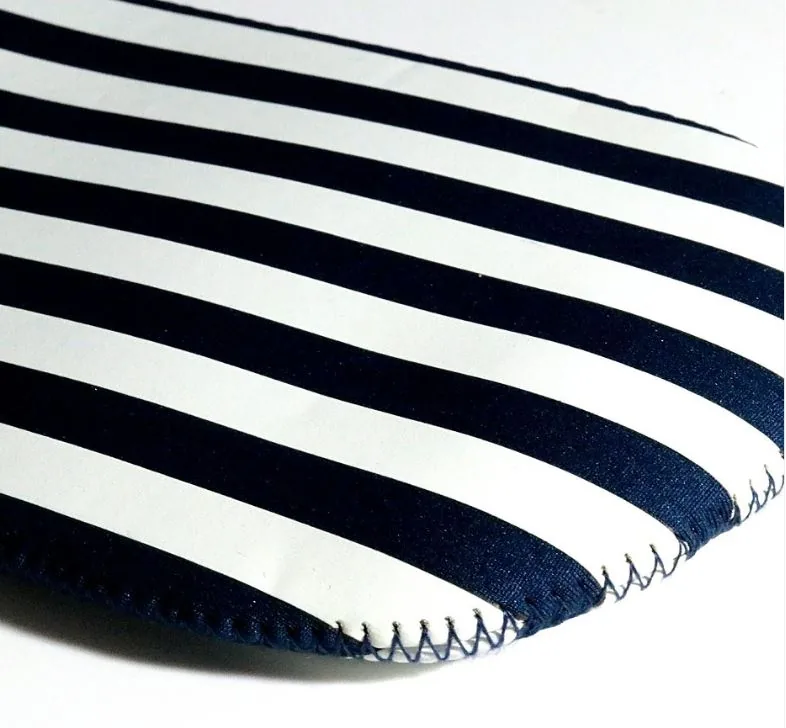
The NEO01 image is a Benshine format and edge-treatment reference. Confirm the exact production material, construction and performance for each enquiry.
Control stitching as part of the material system
Needle size, point, thread, stitch type, stitch spacing, tension and presser-foot setup interact with the laminate. Poor coordination can create skipped stitches, puckering, cut edges, visible holes or seam growth. More stitches are not automatically stronger because dense perforations may weaken some assemblies.
Create a seam map for major joins, edge finishing, zipper attachment, webbing anchors and high-bulk transitions. Approve face and reverse appearance, stretch response, start and end treatment and repair rules. The bag stitch-length guide explains how to measure and control spacing by seam location.
Reinforce handles, straps and hardware deliberately
A soft panel can deform around concentrated loads. Handles, shoulder straps, rings, buckles and hook-and-loop patches may need a defined reinforcement that spreads force beyond the attachment stitches. Specify reinforcement material, size, orientation and position inside the assembly.
Test with the representative bag, contents, packed mass, carry direction and cycle or static method required by the project. Check the panel, reinforcement, stitching and hardware together. A strong webbing does not prove that its attachment to the soft body is strong.
For component selection and routing, use the bag zippers, buckles, webbing and hardware guide.
Choose closures around access and fit
Zippers can provide controlled access but introduce relatively inelastic tape, teeth, end stops and seam bulk. Hook-and-loop, snaps, elastic, drawcords and flaps create different opening forces and contact points. Define the item path, required clear opening and whether the user operates the closure while the material is stretched.
On a fitted sleeve, a small dimension change can alter zipper alignment or make insertion difficult. On a shoulder carrier, the closure must be reviewed with the bag hanging under representative load. Approve stop positions, puller access and protection from hard components where relevant.
Neoprene bag printing depends on the textile face
The logo is normally applied to the surface textile or to a component attached to it, not to an abstract “neoprene” category. Print selection depends on face-fabric fibre and texture, colour, coating, stretch, heat sensitivity, artwork coverage, registration and expected exposure.
Potential directions can include screen printing, transfer processes, sublimation on a suitable prepared face, embroidery, patches or labels. Each has limits. Heat and pressure can change the laminate; heavy ink coverage can affect hand and stretch; embroidery introduces needle holes and reverse-side threads; a patch adds local stiffness.
Approve a strike-off on the exact colour and laminated construction. Review colour, edge definition, opacity, registration, hand, distortion when stretched and the project’s rubbing, flexing, cleaning or ageing method. Read the screen printing, heat transfer and embroidery comparison before freezing artwork.
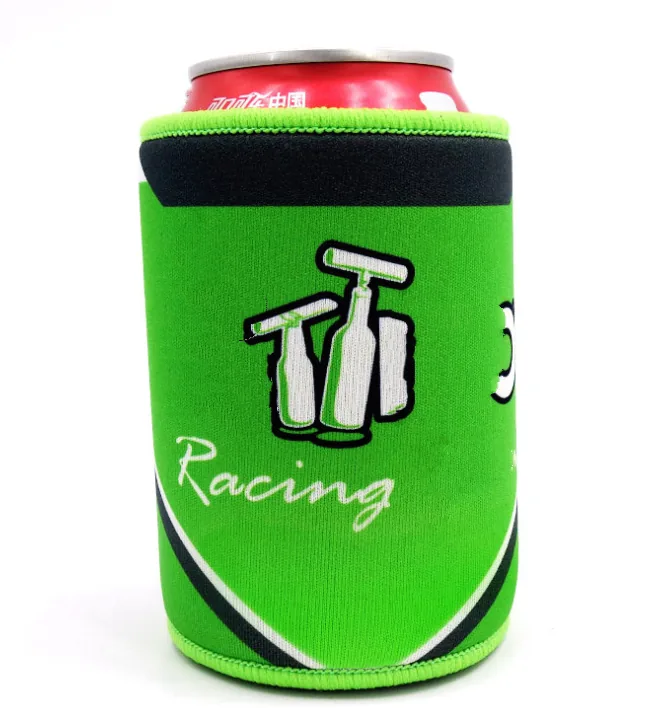
A fitted printed sleeve illustrates how geometry, stretch orientation and surface branding interact. It does not by itself establish material identity or thermal performance.
Water resistance is not the same as a waterproof bag
A closed-cell or low-absorption core description, when documented, still does not make the finished bag waterproof. Textile faces can wet, cut edges expose layers, and stitching creates holes. Zippers, openings, seams, pockets and attachments can admit water.
Define the exposure: light splash, rain, standing water, spray or immersion are different conditions. Name the protected zone and acceptable ingress, then test the complete closed bag with a repeatable procedure. The water-resistant versus waterproof bag guide provides a claim and test framework.
Thermal performance belongs to the complete bag
A soft foam-like core may slow heat transfer, but thickness and material name do not establish a holding time. Fit, exposed edges, seam paths, closure, internal air volume, contents, starting temperature, coolant, ambient conditions and opening frequency influence results.
A fitted can sleeve, bottle carrier and lidded cooler bag are different thermal systems. If the project requires a temperature claim, define the contents, fill arrangement, starting and ambient conditions, probe locations, opening schedule, duration and acceptance rule. Compare finished samples under the same protocol. See the insulated cooler bag construction guide for the full system.
Chemical, temperature and contact claims require exact evidence
Do not describe a generic neoprene bag as chemically stable or suitable across a wide temperature range. The answer depends on the exact core, face fabric, adhesive, ink, thread, edge finish and duration of exposure. A material data sheet can help define scope, but a finished product contains more than one material.
For skin contact, odour-sensitive contents, children’s use, medical workflows, direct food contact or exposure to oils and cleaners, document the actual contact, temperature, duration and target market. Map required evidence to the exact production materials and components. A visual sample or broad supplier declaration is not universal proof.
Sustainability claims need specific, traceable facts
“Reusable,” “durable” and “eco-friendly” are not interchangeable. If a project uses recycled face fabric, reduced-material construction, certified content or another environmental direction, identify the claimed component, percentage or chain-of-custody basis, calculation method, evidence owner and applicable market wording.
Also consider production yield, offcuts, mixed-material lamination, replaceable components, expected care and realistic end-of-life pathways. Do not claim that a whole bag is recycled, recyclable, biodegradable or environmentally preferable because one component has an environmental attribute.
Build a controlled swatch and sample plan
Use stages so material and construction decisions remain traceable:
- Requirement brief: define item, use, contact, environment, fit and performance questions.
- Identified swatches: compare supplier codes with complete layer descriptions and available evidence.
- Process trials: check cutting, edge treatment, sewing, lamination response and branding.
- Fit mock-up: confirm item insertion, opening, stretch direction and usable space.
- Functional sample: include closures, reinforcements, handles, printing and all material layers.
- Use-based tests: apply only the named fit, load, water, thermal, cleaning or other protocols required.
- Pre-production sample: freeze the pattern, bill of materials, workmanship and approved artwork.
A change in core grade, textile face, adhesive, thickness, colour, print process or pattern can affect earlier findings. Record substitutions and decide which approvals or tests must be repeated.
Production quality-control points
Order-specific inspection can cover:
- supplier code, roll identification and approved material reference;
- face fabric, side orientation, colour, texture and surface condition;
- core and total thickness under the agreed method;
- lamination bubbles, wrinkles, contamination and edge lifting;
- cutting cleanliness and part orientation;
- finished dimensions and representative-item fit;
- edge finish, stitch spacing, tension and skipped stitches;
- seam and corner bulk;
- zipper, closure and opening function;
- reinforcement position and attachment workmanship;
- artwork size, position, colour and surface condition;
- project-specific functional checks;
- cleanliness, odour criteria if defined, packing and traceability;
- conformity to approved sample and revision.
Sampling does not prove every unit. Connect incoming material checks, first-piece approval, in-line controls and pre-shipment review using the custom bag quality-control guide.
Custom neoprene bag RFQ checklist
Send the manufacturer:
- intended item, use scenario and user interaction;
- item dimensions, mass and any supplied physical reference;
- finished outside dimensions, usable space and fit direction;
- preferred format, shape and pattern drawing;
- exact core or supplier-grade requirement;
- side A and side B face fabrics;
- core and total thickness, tolerance and measurement method;
- colour, texture, stretch orientation and hand reference;
- seam, edge, binding and corner construction;
- zipper, hook-and-loop, snap, elastic or other closure;
- handles, straps, webbing, hardware and reinforcements;
- artwork files, branding process, dimensions and placement;
- contact, care, cleaning and environmental exposure;
- named fit, load, print, water, thermal or other test protocols;
- target-market documentation and evidence scope;
- approved swatch, sample and change-control requirements;
- quantity by colour, size and version;
- labels, instructions, packing and delivery requirements.
MOQ, price, feasibility and timing depend on the selected construction, tooling, colours, branding, tests, quantity and packaging. Request a current project assessment rather than relying on a generic promise.
Develop the exact material and finished bag together
Benshine can review a neoprene-style sleeve, pouch, carrier or promotional format against the intended item, fit, layer construction, thickness, edge, closure, reinforcement, branding, evidence and test requirements. The NEO-series records are useful visual format references, while the exact production material and claims remain subject to project confirmation.
Explore specialty custom bags, review the NEO01 sleeve reference and NEO05 carrier reference, or send your custom soft-material bag specification.
Quick answers
What is neoprene bag material?
In bag sourcing, neoprene commonly describes a soft sheet construction with a sponge or rubber-like core laminated to one or two textile faces. The commercial name alone does not identify the exact polymer, blend, density, thickness, face fabric, adhesive or performance. Record the complete construction and supplier reference.
Are all neoprene bag materials the same?
No. Suppliers may use neoprene, CR, SBR, blend or neoprene-style wording for different constructions. Core formulation, density, hardness, thickness, surface textile, lamination and finish can vary. Compare identified swatches and finished samples rather than relying on the generic name.
What thickness should a neoprene bag use?
There is no universal thickness. Choose after defining the item, fit, flexibility, edge treatment, seam bulk, desired body and required test. Confirm whether the number means core thickness or total laminated thickness, state the measuring method and tolerance, then validate the finished sample.
Is a neoprene bag waterproof or insulated?
Not automatically. A sheet may resist water or slow heat transfer under some conditions, while stitches, openings, zippers, cut edges and other components remain entry or heat-transfer paths. Waterproof and thermal claims require a defined finished-bag construction and test protocol.
Can a logo be printed on neoprene bag material?
Many laminated textile surfaces can accept a suitable print or transfer process, but compatibility depends on the face fabric, colour, texture, stretch, heat sensitivity, artwork and durability requirement. Approve a strike-off on the exact production construction before bulk production.
What should a custom neoprene bag RFQ include?
Include intended item and use, finished dimensions and fit, exact material construction, core and total thickness, face fabrics, colour, edge and seam methods, closures, reinforcement, branding, test protocols, target-market evidence, quantity by version, packaging and delivery requirements.